posts
The Sedevacantist, or the Adulterous Husband of the Suffering Church
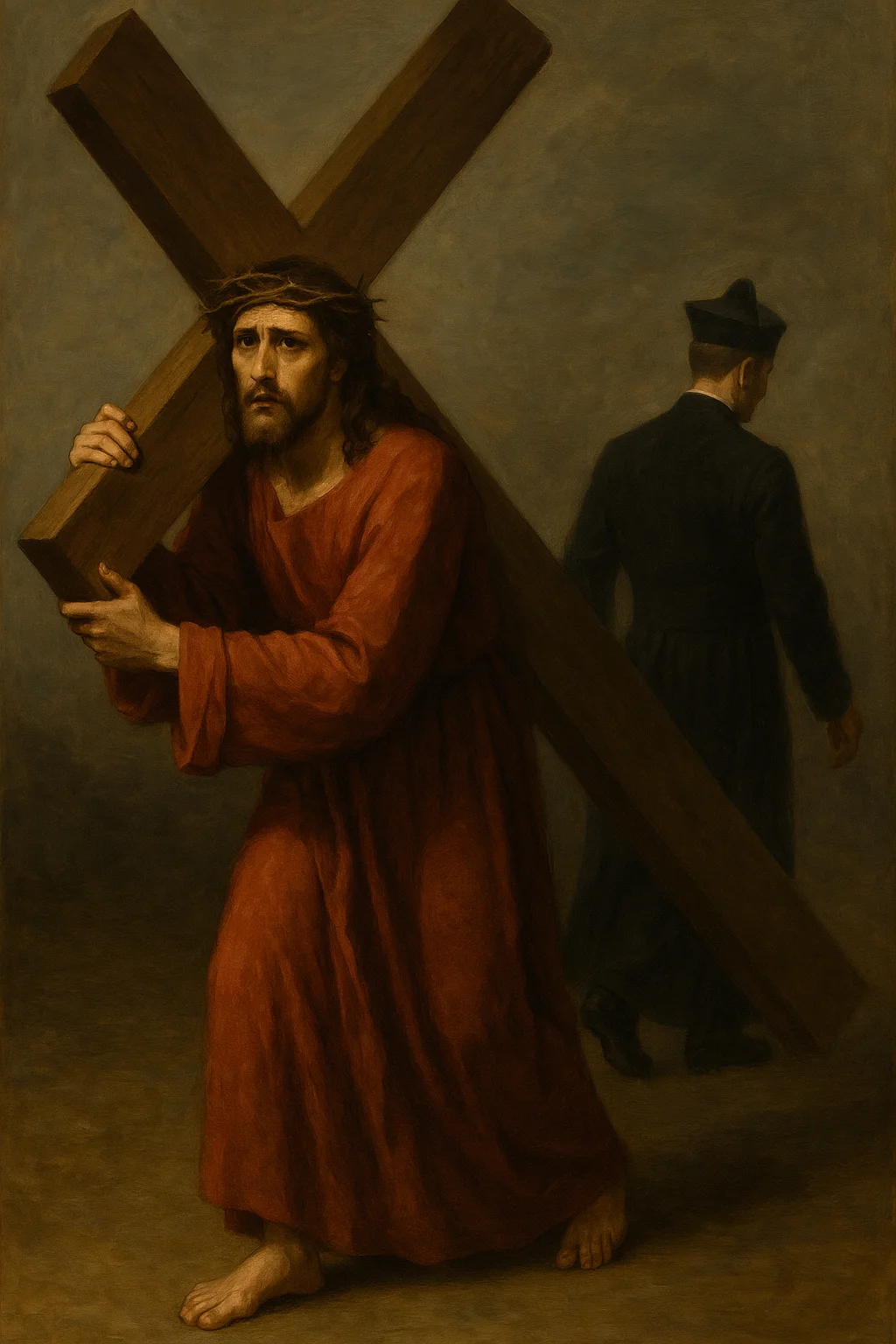
The Sedevacantist, or the Adulterous Husband
He presents himself as the last of the righteous. He proclaims that he refuses compromise, that he will never bend, that he would rather die than commune with error. One might almost admire him — if his supposed fidelity did not reveal itself for exactly what it is: a desertion disguised as heroism.
For when the Church suffers — he leaves.
Not to rescue her. Not to keep vigil at her bedside. Not to share in the Passion. No. He looks at her, sick, feverish, dislocated… and he concludes that his own dignity cannot tolerate such a spectacle. He turns away at the very moment when charity demands perseverance. He proclaims himself a defender of purity — but he refuses to love in ugliness.
That is why the sedevacantist is not a martyr of the faith.
He is the adulterous husband.
I. He does not defend the Church — he constitutes a little church of his own
Saint Ignatius of Antioch:
“Where the bishop is, there is the community; where Christ is, there is the Catholic Church.”
The sedevacantist reverses the logic:
“Where my thesis is, there is the Church.”
He no longer receives communion — he dispenses it. He does not submit to the Church — he examines the Church to determine whether she is still worthy of his obedience.
Saint Cyprian already described this mechanism:
“They claim to defend unity while separating themselves; they build an altar against the altar.”
Sedevacantism is therefore not a defense of Tradition — it is the reconstitution of a closed community, defined not by apostolic succession but by adherence to a thesis.
II. He believes he is fleeing modernism — he embodies its religious version
The modernist reduces the Church to a human institution to be reformed.
The sedevacantist reduces the Church to a juridical mechanism to be validated.
Same logic, same coldness, same forgetfulness: the Church is not a machine but an organism.
Saint Paul:
“If one member suffers, all suffer together.” (1 Cor 12:26)
Saint Augustine:
“The unworthiness of the minister does not destroy the sacrament.” (Contra ep. Parmeniani)
But he no longer sees the organism — only the failure. He does not seek the wounded Christ — he checks boxes. He thinks like a technician of the sacred, not like a son of the Church.
III. He is not the antidote to Protestantism — he is its ultimate mutation
Luther said: “Rome has erred; therefore I must leave her.”
The sedevacantist says: “Rome cannot err; therefore, if I see an error, it is no longer Rome.”
In both cases:
Private judgment becomes the Magisterium.
Saint Vincent of Lérins foresaw it:
“They wish to choose within the Church what pleases them, and reject what displeases them.” (Commonitorium)
Protestantism began with “I leave Rome.”
Sedevacantism completes the revolution with “Rome exists only if I declare her valid.”
IV. He does not pray the Church — he scans her: autistic religiosity
The tragedy is not only doctrinal — it is cognitive.
The sedevacantist thinks like an analysis engine, not like a loving body. He does not contemplate — he detects. He does not endure — he eliminates. He does not live in charity — he operates in bug-logic.
This is not clinical autism that is meant here — it is spiritual autism, the sensory closure to nuance, mystery, and the temporality of grace. He does not know forgiveness; he does not understand convalescence. The Church has no right to be sick — she must be perfect or declared dead.
He cannot bear a wounded Body — he demands an immaculate idea.
It is algorithmic perfectionism. No compassion, no mercy, no slow fidelity.
A scanner with a rosary.
V. He refuses communion — in the name of the Sacrifice of Cain
The ultimate point of sedevacantism is not a thesis on the papacy. It is a refusal to kneel.
He claims that the Masses celebrated in the visible Church are no longer valid, that priests in communion with Rome offer no longer the Sacrifice of Abel, but the sacrifice of Cain.
According to him, the altar of the majority of Catholics has become an impure table; the delivered Body of Jesus a simulacrum; the chalice presented an offense rather than an offering.
We are no longer here in criticism — we are in wild excommunication.
Saint Augustine had already answered those who, like the Donatists, refused to commune with the “sinners” of the Church:
“Those who refuse to commune with their brothers are not pure, but proud. It is not the fault of others that separates them, but their own hardness.”
(Sermon 23)
The refusal of communion is the Luciferian sin of personal purity.
The sedevacantist does not merely say:
“I will not commune among them.”
He says:
“What they adore is not Christ — it is an abomination.”
This is the most radical form of schism: he does not only refuse authority — he refuses the Presence.
He cannot conceive that Christ might remain in a wounded liturgy — for his mind does not grasp the condescension of God.
He wants a perfect host, celebrated by perfect hands, in a perfect Church.
But then it is no longer the Sacrifice of Christ —
it is the banquet of the Pharisees.
Conclusion — He is not a confessor of the faith: he is a husband who flees
Saint John Chrysostom:
“To endure the faults of the Church is to participate in the cross of Christ; but to separate oneself from her is to strike Him Himself.”
The sedevacantist does not endure. He judges.
He does not enter into the Passion — he asks for a divorce.
His wife is sick; he leaves.
She coughs blood; he goes out for air.
She no longer has the face she once had? He declares she is no longer herself.
He calls this zeal for truth.
Heaven calls it betrayal in white gloves.
The ultimate criterion of fidelity is not doctrinal correctness — but the capacity to love when the other no longer deserves to be loved.
The sedevacantist is orthographically pure and theologically dry.
He knows how to defend purity — but he does not know how to love.
And the Church does not need vigilantes.
She needs husbands — who stay, even when she bleeds.